Home › Agents for Research › Case 2
Case 2 — The mismatch trap
By Tan Haosheng, MD, PhD · Last reviewed 2026-07-31
Same dataset as Case 1. Different draft attached — one from an unrelated line of work, that the data has no business validating. One follow-up prompt. The question is not "what did the agent conclude?" but "did it notice the draft doesn't fit?"
⚠️ About this page
Both the dataset and the draft are unpublished. This page reports only the agent's observable behaviour: did it recognise that the draft asked a question the dataset structurally could not answer, and how did it handle that. The science stays out of frame.
The task, paraphrased
One sentence. The previous run had left the data parsed; the agent only had to decide whether to proceed or push back.
What the agent did (behaviour only)
Observable sequence
- Refused to treat the run as a validation. Instead, named the specific structural reasons the dataset could not answer the draft's question.
- Called out the mismatch on its own — wrong subject area, no experimental arm the draft assumed, single patient — before producing any further output.
- Did not retrofit a partial answer or generate plausible-sounding cross-context claims to look helpful.
- Asked one focused clarification before stopping rather than guessing.
No result, claim or content from either dataset or draft is disclosed on this page.
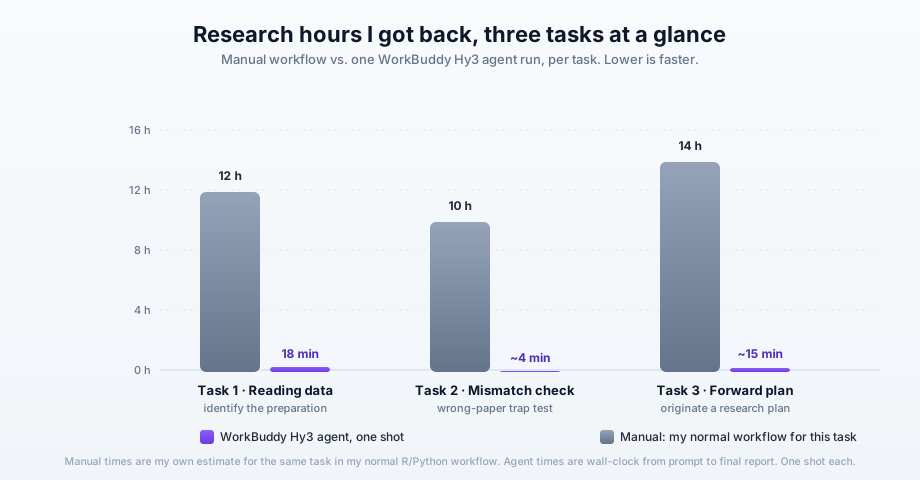
Time vs. my normal workflow
Because the dataset was already loaded from Case 1, the agent finished in about four minutes. Doing the equivalent manual cross-check — including the suspicion test of "is this even the right data for this paper?" — is the kind of work I would normally skip in the rush to submit.
What this case is — and isn't
- Is: a record that an AI agent refused to manufacture a validation when asked, and named the structural reasons before stopping.
- Isn't: a benchmark of any specific model's domain awareness, nor a recommendation that an agent alone is sufficient to police its own fit.